
Cloud-Based vs Desktop Legal Software: Which Is Better for Malaysian Law Firms?
Malaysian law firms are under more pressure than ever to modernise. Between LHDN's e-Invoice mandate, SST compliance requirements, hybrid working arrangements, and clients who expect faster turnaround times, the old filing cabinet and standalone spreadsheet approach is quickly becoming a liability rather than a workflow.
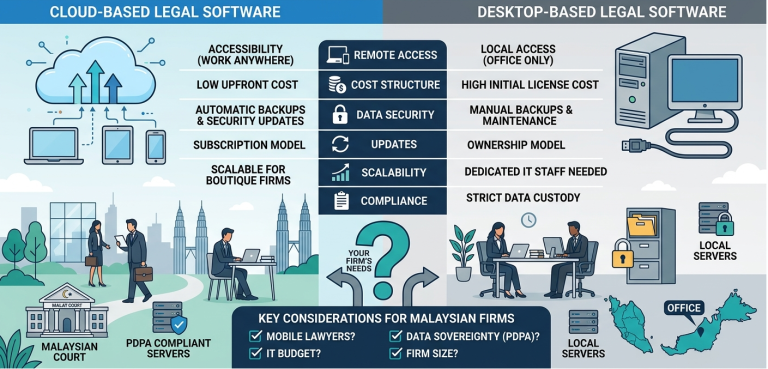
At the centre of this shift is a simple but important decision: Cloud Based vs Desktop Legal Software — should your firm run in the cloud or stick with a traditional on-premise system? The answer affects everything from your monthly IT budget to how quickly your associates can bill a file after a court appearance.
This article breaks down the real differences in the Cloud Based vs Desktop Legal Software debate, and why an increasing number of conveyancing, litigation, and corporate law firms in Malaysia are making the switch to cloud-based platforms like EasyPro.
What Is Desktop Legal Software?
Desktop legal software is installed directly onto a specific computer or a firm's local server. It has been the standard in Malaysian legal practices for decades, largely because early case management and accounting systems were built before cloud infrastructure was reliable or affordable.
Typical characteristics of desktop legal software:
- Installed on individual workstations or an on-premise server
- Data is stored locally, usually within the firm's own office
- Requires the firm to manage its own hardware, backups, and IT maintenance
- Often licensed per device, with limited access outside the office network
- Updates and patches usually need to be installed manually by IT staff
What Is Cloud-Based Legal Software?
Cloud-based legal software, on the other hand, runs on secure remote servers and is accessed through a web browser or app — from any device, at any location, as long as there's an internet connection.
Typical characteristics of cloud-based legal software:
- Hosted and maintained by the software provider
- Accessible from the office, at court, or working from home
- Automatic updates, including for regulatory changes like e-Invoice or SST
- Data backups and security handled centrally by the provider
- Usually subscription-based, with lower upfront costs
This is the model that platforms like EasyPro are built on — an all-in-one law firm accounting and case management system designed specifically around how Malaysian firms actually operate.
Cloud Based vs Desktop Legal Software: Side-by-Side Comparison
| Factor | Desktop Legal Software | Cloud-Based Legal Software |
|---|---|---|
| Accessibility | Office-bound; limited remote access | Work from anywhere with internet access |
| Upfront Cost | High (hardware, servers, licences) | Lower, predictable subscription pricing |
| Maintenance | Managed in-house by firm's IT | Handled by the software provider |
| Updates & Compliance | Manual installation, can lag behind regulation changes | Automatic updates, faster compliance rollout |
| Data Backup | Firm's responsibility | Centralised, provider-managed backups |
| Scalability | Requires new hardware/licences to expand | Scales easily as the firm grows |
| Collaboration | Limited to local network | Real-time access across partners, associates, and staff |
| Disaster Recovery | Vulnerable to local hardware failure, fire, flood | Data stored off-site, reducing single-point-of-failure risk |
Why Malaysian Law Firms Are Shifting to the Cloud
1. Work From Anywhere, Without Compromising Case Files
Court mentions, client meetings outside the office, and staff working from home are now routine. Cloud-based platforms let fee earners access case files, client records, and billing information securely, whether they're in the office in Petaling Jaya or attending a hearing in another state.
2. Built-In Compliance With Malaysian Regulations
LHDN's e-Invoice requirements and ongoing SST obligations mean legal software needs to evolve constantly. A cloud platform can push these regulatory updates to every user instantly, without a firm needing to schedule an IT visit or manually patch every workstation. This is one of the clearest advantages cloud systems have over desktop software when it comes to staying compliant.
3. Lower IT Overheads
Desktop systems typically require a firm to invest in servers, maintain them, and pay for IT support to keep everything running. Cloud-based software shifts that burden to the provider, which is particularly valuable for small to mid-sized firms that don't have a dedicated IT department.
4. Centralised Client and Trust Accounting
Separating office accounts from client accounts, tracking trust fee transfers, and reconciling bank transactions accurately are core requirements for any Malaysian legal practice. Cloud-based accounting modules keep this data centralised and auditable, reducing the risk of errors that come from juggling disconnected spreadsheets or offline systems.
5. Better Disaster Recovery
A desktop system tied to a single office server is vulnerable to hardware failure, theft, fire, or flooding — all real risks in Malaysia's climate. Cloud-hosted data is stored securely off-site, so a firm's case history and financial records aren't dependent on the condition of one physical machine.
Cloud Based vs Desktop Legal Software: When Might Desktop Still Make Sense?
To be fair, desktop software isn't without its arguments. Some firms prefer it because:
- They have deep concerns about internet dependency in areas with unreliable connectivity
- They've already invested heavily in an existing on-premise system
- They prefer having complete physical control over where data is stored
That said, for most modern law firms in Malaysia — particularly those handling conveyancing, litigation, or corporate matters with multiple fee earners — the operational flexibility and compliance benefits of cloud-based systems generally outweigh these concerns, especially as internet infrastructure across Malaysia continues to improve.
Making the Switch: What to Look for in a Cloud-Based Legal Software
If your firm is considering a move to the cloud, look for a platform that offers:
- Integrated case and client management — not just accounting, but full file digitisation and client record linking
- Automated billing and quoting — reducing manual invoice preparation and tracking overdue payments
- Proper trust and office account separation — a non-negotiable for Malaysian legal compliance
- E-Invoice readiness — so your firm isn't scrambling every time LHDN updates requirements
- Document automation — templated drafting for court documents, letters, and agreements
- Role-based security controls — so partners, associates, and support staff only see what they need to
Why EasyPro Fits Malaysian Law Firms
EasyPro is a cloud-based legal management and accounting software built specifically for Malaysian law firms — whether the practice focuses on conveyancing, litigation, or corporate work. It brings together case management, client management, document drafting, billing, and accounting into a single system, with separated office and client accounts, trust fee tracking, and e-Invoice-ready features to keep firms aligned with LHDN requirements.
Because it's cloud-based, EasyPro lets partners and fee earners work from anywhere, while giving firm administrators centralised oversight through analytics dashboards and business reports — without the overhead of maintaining an in-house server.
Cloud Based vs Desktop Legal Software: Final Verdict
Weighing up Cloud Based vs Desktop Legal Software, cloud-based systems come out ahead for most Malaysian law firms today. It reduces IT overhead, keeps firms current with fast-changing compliance requirements like e-Invoice, supports flexible and remote work, and protects critical case and financial data from the risks that come with relying on a single physical server.
Desktop software isn't obsolete, but its advantages are narrowing every year — while the gap in flexibility, compliance readiness, and scalability continues to widen in favour of the cloud.
If you're evaluating a move to cloud-based legal management, EasyPro offers a demo so you can see how it fits your firm's specific practice areas and workflow before making the switch.