
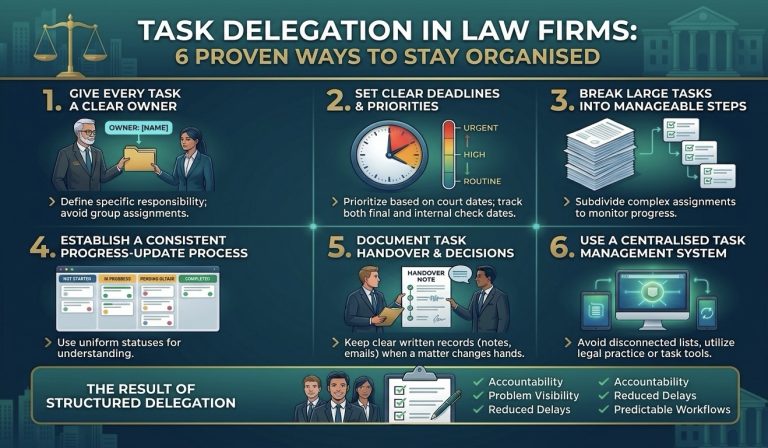
Effective task delegation in law firms teams starts with teamwork. Lawyers, legal assistants, clerks and administrative staff often need to coordinate their work to move a matter forward.
One person may prepare a document, another may review it, and someone else may need to contact the client or arrange the next step.
When responsibilities are clearly defined, the team can work towards the same goal. However, when tasks are assigned informally or tracked inconsistently, important actions can be delayed or overlooked.Good task delegation in law firm teams means everyone knows who is doing what, and by when.
A staff member may assume that a colleague is handling a request. A deadline may be mentioned in a conversation but never added to a task list. A manager may have to ask several people for an update because there is no clear record of progress.
These challenges do not necessarily mean the team is unproductive. They may indicate that the firm's task delegation process needs improvement.
Here are six ways to build a more organised and accountable workflow.
1. Give Every Task a Clear Owner
A common source of confusion is assigning work to a group without identifying who is responsible for completing it.
For example, a manager might tell the team, “Please arrange the documents for this matter.”
Everyone may understand what needs to be done, but no individual has been explicitly assigned responsibility. As a result, the task may remain incomplete while each person assumes someone else will handle it.
To prevent this, every task should have a clearly identified owner.
A useful task description should include:
- The action required.
- The person responsible.
- The expected completion date.
- The relevant client or matter.
- Any dependencies or instructions.
Consider this example:
| Task | Owner | Due date |
|---|---|---|
| Obtain missing client documents | Assigned clerk | 20 October |
| Review draft agreement | Assigned lawyer | 22 October |
| Confirm next steps with client | Matter owner | 23 October |
These dates are illustrative rather than recommended legal deadlines.
Clear ownership does not mean one person must complete every part of a task alone. It means someone is responsible for coordinating the work and ensuring that the next action is taken.
2. Set Clear Deadlines and Priorities
Not all tasks carry the same level of urgency.
A routine administrative update may be scheduled for later, while a matter involving a court deadline or an urgent client requirement may need immediate attention.
If every task is treated as equally important, staff may struggle to decide what to work on first.
A better approach is to define priorities and deadlines when tasks are created.
For example, tasks could be classified as:
- Urgent: Requires prompt attention due to an imminent deadline or material risk.
- High priority: Important work that should be completed within a defined timeframe.
- Routine: Standard administrative or operational work that can be scheduled.
- Pending: Work that cannot proceed until information or approval is received.
These categories should be supported by clear internal rules. They must not replace the formal tracking of court deadlines, statutory requirements or other critical dates.Firms can also refer to the Malaysian Judiciary website for official court information.
Where appropriate, record both the due date and any earlier internal review date. This gives the team time to check the work before the final deadline.
3. Break Large Tasks Into Manageable Steps
Some assignments are too broad to monitor effectively as a single task.
For example, “Prepare the documents for the matter” may involve collecting information, reviewing records, drafting documents, obtaining approval and arranging delivery.
If the entire assignment is recorded as one item, it may be difficult to identify where progress has stalled.
Breaking larger assignments into smaller steps makes the workflow more visible.Smaller steps make task delegation in law firm workflows easier to track and review.
A task might be divided into:
- Collect the required information.
- Review the supporting documents.
- Prepare the first draft.
- Submit the draft for review.
- Make the required amendments.
- Confirm completion and save the final document.
Each step can have its own owner or deadline when necessary.
This also helps managers identify dependencies. If the next step cannot proceed because information is missing, the team can record the reason instead of repeatedly asking for general progress updates.
4. Establish a Consistent Progress-Update Process
Without a reliable method for tracking progress, managers may need to contact team members individually to find out what has been completed.
These repeated enquiries consume time and can interrupt work that requires concentration.
A simple progress-update process can make task status easier to understand.
For example, a firm might use the following statuses:
| Status | Meaning |
|---|---|
| Not started | Work has not begun |
| In progress | Work is underway |
| Pending information | Waiting for a response or document |
| Pending review | Awaiting approval or checking |
| Completed | The task has been finished and recorded |
The definitions should be consistent across the team. In particular, “completed” should mean that the required work is actually finished, rather than merely started or passed to someone else.
A short daily review or regular team meeting can help identify overdue tasks, blocked work and changing priorities.
The objective is not to monitor every minute of an employee's day. It is to give the team enough visibility to coordinate work and address problems early.A consistent update process keeps task delegation in law firms teams informed without constant follow-ups.
5. Document Task Handover and Decisions
Tasks sometimes change hands when a colleague is on leave, responsibilities are reassigned or a matter requires input from another team member.
If the handover happens only through a brief conversation, the receiving person may not know what has already been done, what remains outstanding or why a particular decision was made.
A useful handover should record:
- The current task status.
- Work completed so far.
- Outstanding actions.
- Relevant documents or communications.
- Pending responses and dependencies.
- The next deadline or follow-up date.
For example, instead of writing “Please take over this matter,” a handover note could state that the initial document has been prepared, the client has been asked to provide a missing item, and the next follow-up is scheduled for a specified date.
This makes it easier for another team member to continue the work without reconstructing the entire history.
The same principle applies when tasks are reassigned temporarily. A written record helps maintain continuity and reduces reliance on one person's memory.Written handover notes protect task delegation in law firms operations when staff are away or responsibilities change.
6. Use a Centralised for Task Delegation in Law firms Teams
Spreadsheets, email flags and personal to-do lists can be useful for individual work. However, when a team relies on several disconnected tools, it can become difficult to see the overall status of its tasks.
A centralised task management system may help a firm:
- Assign tasks to specific team members.
- Associate tasks with clients or matters.
- Set due dates and reminders.
- Record progress and pending actions.
- Review outstanding work in one place.
- Improve visibility when responsibilities change.
EasyPro can be introduced as a potential option for task delegation in law firm workflows, helping firms organise tasks and matters in one place.
Before implementing any system, firms should confirm the functions available in their selected package, how notifications and permissions work, and whether the system fits their existing processes.
Technology should make responsibilities easier to understand, not add another layer of administration.
How to Build Accountability Without Creating Unnecessary Pressure
Accountability is sometimes misunderstood as checking whether every task has been completed immediately.
In a law firm, effective accountability means ensuring that responsibilities are clear, progress is visible and problems are communicated early.
A useful management approach should encourage staff to report blockers before they become serious delays.
For example, if a task depends on a client response, the responsible person should record the pending item and the next follow-up date. If the workload becomes unrealistic, the team should review priorities and reallocate work where appropriate.
Managers can also review recurring delays to identify whether they arise from unclear instructions, excessive workloads, inefficient processes or insufficient training.
This approach focuses on improving the system rather than simply assigning blame when something goes wrong.
A Simple Task Delegation in Law Firms Checklist
Use this checklist when assigning work or reviewing your firm's workflow.
- ☐ Every task has a clear owner.
- ☐ The expected outcome is documented.
- ☐ Deadlines and priorities are recorded.
- ☐ Large assignments are divided into manageable steps.
- ☐ Progress statuses have consistent definitions.
- ☐ Pending information and dependencies are visible.
- ☐ Handover notes are recorded when responsibilities change.
- ☐ Overdue tasks are reviewed regularly.
- ☐ Critical legal deadlines are monitored through appropriate controls.
Review the checklist periodically to ensure that it continues to support the firm's actual working practices.
Conclusion: Make Teamwork More Visible and Consistent
Effective task delegation is essential for a law firm that needs to coordinate multiple matters, people and deadlines.
By assigning clear owners, setting realistic deadlines, breaking down complex assignments and recording progress, firms can reduce confusion and make collaboration more reliable.
A centralised task management system can further support these practices by giving authorised team members a clearer view of outstanding work.
Looking for a more structured way to manage tasks and matter-related workflows? Explore EasyPro to see how its practice management capabilities may support your firm's day-to-day operations.